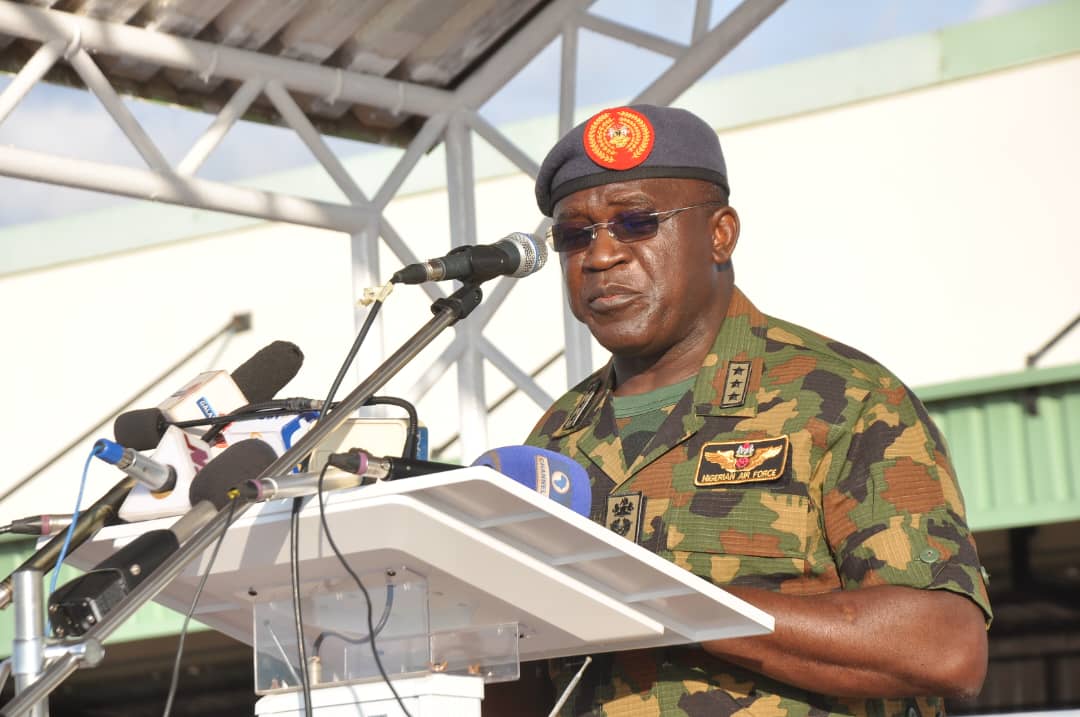
The Nigerian Defence Academy (NDA) embodies and symbolises the country’s unceasing quest for nationhood and the protection of our sovereignty, independence and territorial integrity.
Chief of Staff to the President Federal Republic of Nigeria, His Excellency, Prof.
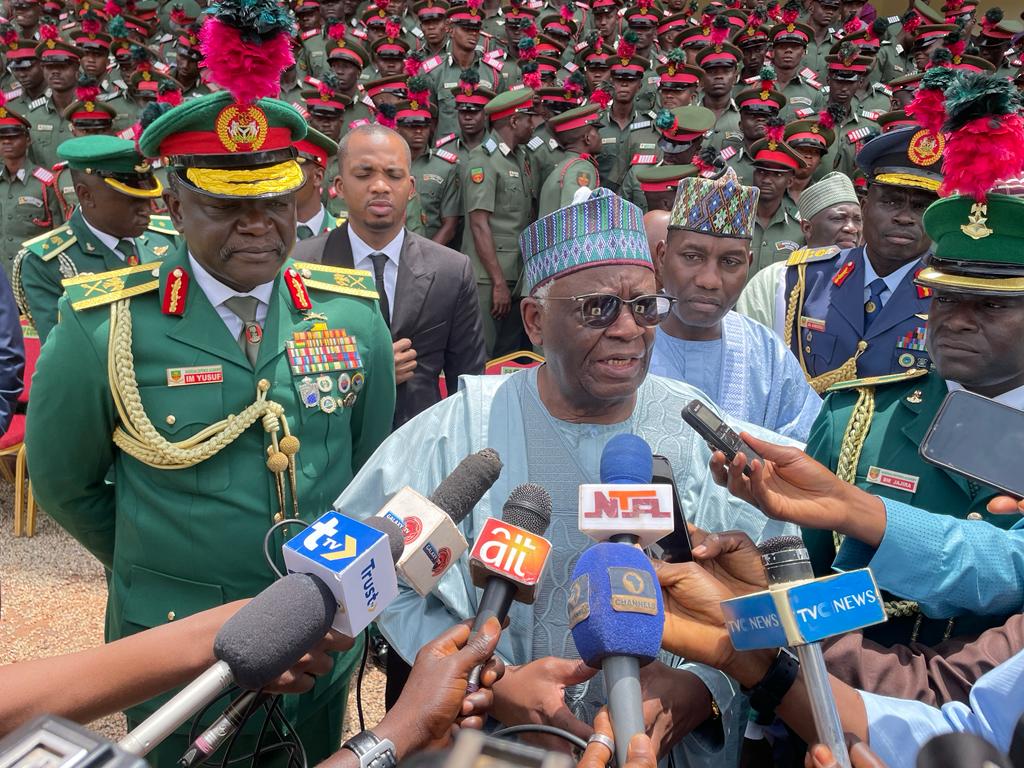
(Amb) Ibrahim Gambari (CFR) expressed this, while delivering a paper, titled, National Security, Defence, and Diplomacy In A Changing World Order at the 20th Convocation Post Graduate Students of NDA On Tuesday September 27, 2022 in Kaduna.
“After all, for those who have followed the evolution of our country since its independence in 1960, it will not be lost on them that the Nigerian Defence Academy embodies and symbolises our unceasing quest for nationhood and the protection of our sovereignty, independence and territorial integrity.
Through the Academy, successive Nigerian leaders have not left any stone unturned to give content and meaning to this quest. In playing its part , the Academy has established itself as a source of national pride for us all.
” In the period since the founding of the Academy in February 1964, its role and place in the making of our nation and the strengthening of our statehood have never been in doubt,” he said.
Speaking during the Lecture Of The Graduation Of The 69th Regular Course, he said that the various senior officers who have served as its NDA’s Commandants at different points in time, have laboured over the years to cultivate, nurture, and uphold the high ideals of excellence for which the Academy has come to be known and respected, not only in Nigeria but across Africa and the world.
” This history and the culture of excellence on which it is built was further bolstered by the decision of the Federal Government to grant the Academy a degree-awarding status – and also much recently, authorise the admission of female cadets.
” In this way, the young men and women who gain entry into the Academy are, after four years of academic training and military training, commissioned into anyone of three services that comprise the Nigerian armed forces fully equipped with the requisite knowledge, aptitudes, and skills required of a modern officer corps,” he said.
Read the full text of his presentation below:
NATIONAL SECURITY, DEFENCE, AND DIPLOMACY IN A CHANGING WORLD ORDER ADDRESS DELIVERED BY HIS EXCELLENCY PROF.
(AMB) IBRAHIM GAMBARI (CFR) CHIEF OF STAFF TO THE PRESIDENT FEDERAL REPUBLIC OF NIGERIA AT THE 20th CONVOCATION POST GRADUATE STUDENTS ON TUESDAY 27th SEPTEMBER 2022
LECTURE OF THE GRADUATION OF THE 69TH REGULAR COURSE
SEPTEMBER 27, 2022
Protocols
1.0 On occasions of this nature, it is customary to begin first by thanking the Commandant of the Nigerian Defence Academy, Major General Ibrahim Manu Yusuf, and the heads and staff of the various Directorates and Academic units of the institution for the honour bestowed upon me to be your convocation speaker. It is not an honour which I take lightly and that is why when the invitation of the Commandant got to me, I had no hesitation whatsoever to accept it despite other competing claims on my time.
2.0 After all, for those who have followed the evolution of our country since its independence in 1960, it will not be lost on them that the Nigerian Defence Academy embodies and symbolises our unceasing quest for nationhood and the protection of our sovereignty, independence and territorial integrity.
3.0 Through the Academy, successive Nigerian leaders have not left any stone unturned to give content and meaning to this quest. In playing its part , the Academy has established itself as a source of national pride for us all. In the period since the founding of the Academy in February 1964, its role and place in the making of our nation and the strengthening of our statehood have never been in doubt. The various senior officers who have served as its Commandants at different points in time have laboured over the years to cultivate, nurture, and uphold the high ideals of excellence for which the Academy has come to be known and respected not only in Nigeria but across Africa and the world. This history and the culture of excellence on which it is built was further bolstered by the decision of the Federal Government to grant the Academy a degree-awarding status – and also much recently, authorise the admission of female cadets. In this way, the young men and women who gain entry into the Academy are, after four years of academic training and military training, commissioned into anyone of three services that comprise the Nigerian armed forces fully equipped with the requisite knowledge, aptitudes, and skills required of a modern officer corps.
4.0 These years of intense training for the graduating cadets is a major investment made by the armed forces, the government, and the country to ensure that the Army, the Navy, and the Air Force continue to receive a steady stream of young officers to whom, over time, the leadership of the services and the management of our national defence can be entrusted in accordance with a time honoured system of orderly succession that has been perfected over the years.
5.0 For the graduating officer cadets themselves, this ceremony is the culmination of a journey that has been characterised by hard work, discipline, integrity, courage, and abnegation, key requirements for selfless and patriotic service to the country that you have sworn, through thick and thin, to defend at all times. It is appropriate, therefore, to extend hearty congratulations to every one of you, the graduands.
6.0 This convocation ceremony is coming at a time when the world is in the throes of significant geo-political changes with seismic effects, that are already producing realignments that foreshadow a new world order that is to come. The scholarly literature is replete with debates about the contours and depth of the changes. These debates are interesting for those who may wish to follow them closely, but they need not detain us here and now. What is crucial is that none of the competing perspectives in the conversation contests the idea that we are living through a period of change.
7.0 Building on this fact, it is useful from the outset to note that periods of such major changes in world history, where a reconfiguration of relations of power takes place have also usually been extremely delicate, if not outrightly dangerous. It has not been uncommon in world history that the shifts from one dominant or hegemonic order to another have either involved wars or been incubated and delivered in the context of war. In the context of the ongoing shifts in the balance of power and influence which we are witnessing around us, it is important, therefore, that adequate and timely preparations are made to protect our core national interest, including the safeguarding of our independence and territorial integrity, the advancement of the welfare and dignity of our people, and the assertion of the rightful place of our country and continent at the rendezvous of civilisations. To do so, we must prepare ourselves for various scenarios and develop appropriate action plans that flow from them.
8.0 These are responsibilities that belong to us all as leaders and citizens insofar as success in meeting them will be to our collective benefit and pride, failure will as well mean our collective defeat and shame. Defeat, however, will be too costly for us as a country, for Africa as a continent, and for all persons of African descent around the world to contemplate.
9.0 Contemporary change in the international system is unfolding at multiple levels and in several sectors simultaneously. Some of the key aspects of change are also inter-connected, playing themselves out in a manner that is mutually reinforcing. Demographically, we are witnessing a process of the re-composition of populations on a global scale which has seen large-scale ageing in one part of the world and massive youthfulness in the other, amidst an overall continuing growth in the number of humans on the planet. Thus, whereas in some parts of the world, population growth rates are negative in the worst cases, and the proportion of the old is higher or accelerating more quickly compared to the young, in some other parts such as Africa, growth rates remain relatively high, and the youth comprise as much as 60 per cent of the total population. Our country, Nigeria, is in the category of those countries that are experiencing a comparatively high rate of population growth. That population boom is expressed in terms of a continued steady expansion in the total number of Nigerians and, within it, a youth bulge that speaks to the fact that a major part of our population demographic comprises of Nigerians under the age of 35.
10.0 Conventional indicators of potential power and influence in international relations include the population endowment of countries. Nigeria, by 2050, will emerge as the third or fourth most populous country in the world after India and China. Converting this endowment into real power and influence will require conscious policy and political efforts, including the harnessing of the youth dividend into a potent instrument of national transformation and impactful global presence.
11.0 The world is also witnessing a continuing revolution in information and communication technologies (ICTs). This revolution has played a key role in propelling contemporary globalisation by leaps and bounds to expand its scope and reach while deepening crossborder interconnections and interdependence to levels and dimension previously known. And although geography has not by any means been erased in global affairs as some early globalisation enthusiasts once claimed prematurely, the world has certainly become more closely knit together. Embedded in the ICT revolution is the expansion of digital technologies, artificial intelligence, and innovative applications which are driving a reorganisation of the economy and society everywhere, the frenetic expansion of online virtual communities and markets, and the opening up of new possibilities with the internet of things, the consolidation of the global media, and the emergence of the Fourth Industrial Revolution.
12.0 Such is the breadth, width, and depth of the ongoing ICT revolution that the entire spectrum of national, regional and international affairs is being transformed under its influence and impact. From everyday governance of state-society relations and the delivery of health care, education, and other social services to the organisation of citizen safety and security at home and abroad, and
the management of cross-border ties, the impact and consequences of ICTs are making themselves felt in every way and every sphere. Even the conduct of war is entering an entirely new age with the increasing deployment of internet and satellite technologies alongside innovations in the deployment of drones and hypersonic weaponry.
13.0 The ICT Revolution is already producing massive changes in the conduct of politics among nations. Change is also taking place in global climatic patterns. It is no longer news to most people on our planet that global temperatures have been warming at an accelerated pace in recent years, creating an emergency that leaders are seeking to address under the auspices of the United Nations. The impact of global climate change is already being felt, inter alia, in the form of frequent and unusually ferocious storms of various categories, the increasingly unpredictable weather patterns that disrupt our long-established sense of the seasons, agricultural cycles, and pastoralist activities, and the frequent and devastating wildfires in forested land sparked or fuelled by high temperatures and winds. Higher temperatures are also claiming lives in increasing numbers either directly in erstwhile fully temperate regions of the world or through the droughts that they unleash in different parts of the tropics. Most recently, the flood in Pakistan submerged one third of the country, with over 1,300 people dead.
14.0 The consensus is now widespread, although the required collective political will is still lacking, that unless serious mitigation and adaptation steps are taken to slow – and eventually reverse – global climate change, humanity may be headed for a serious disaster. In the interim, there are many implications of climate change for governance, social policy, food security, population movement, inter-communal relations, and national defence which are already playing themselves out. Like other places around the world, our country has not been spared these consequences even if their manifestation and impact may be uneven across jurisdictions.
15.0 Indeed, across Nigeria, various climate-related conflicts have emerged and played out violently, eroding inter-communal peace and solidarity, fuelling conflicts over access to water resources and pasture, and giving birth to various forms of criminality, local and cross-border including especially the lake Chad Basin.
16.0 The fourth dimension of global change and one which has been gradually making itself manifest is the re-emergence of some of the leading countries in the East as key actors in the international system in a process which suggests that the global pendulum may be swinging, inexorably, away from the unrivalled dominance hitherto enjoyed by United States (US). Pax Americana first began to be felt in the period leading up to the Second World War; by the end of the War, it had consolidated itself, leaving no doubt about the pre-eminence that the US claimed in world affairs. Its success in supplanting Pax Britannia (when at it’s height, the British Empire covered one-quarter of the earth and one-fifth of its population), covered whose impact and reach was felt all around the world while it lasted, placed it in a pole position to lead the shaping of the post-War global order, including its underlying rules and institutional arrangements. Thus, it was that global institutions such as the UN, the IMF, and the World Bank came to bear the strong imprint of the US. Even if the world was not exactly unipolar, the US stood head and shoulders above other great powers in the international system.
17.0 The dominance that the US enjoyed encompassed all indicators of power: Economic prowess embodied globally by, inter alia, the reach of its multinationals and reflected at home in the gigantic size of its gross domestic product; military strength embodied in its ownership of the deadliest arsenal of weapons of deterrence and war; technological superiority manifested in its leadership in research and innovation; and diplomatic clout expressed in terms of the massive leverage it exercised in world affairs. This unrivalled dominance continued for much of the period to the 1970s when serious challenges began to sprout from various quarters, including among allies in Europe who launched the first steps towards what is now the European Union, and Japan which rose rapidly to become the second biggest economy in the world after the US itself.
18.0 If European regional economic cooperation and the emergence of Japan as a global economic force mostly amounted to friendly competition against the US within the same broad group of allied countries that enjoyed the military-security cover provided to them by Washington, the re-emergence of China leading a pack of other countries such as India and Russia, and, more recently, Turkey and Saudi Arabia among a raft of middle powers, points to the acceleration of a process of the greater dispersal of global power among various actors. An increasingly multi-polar world is replacing the apparent uni-polar configuration of power especially in the aftermath of the collapse of the Soviet Union.
19.0 China in particular very rapidly overtook Europe and Japan to become the keenest competitor to the US in economic terms. Indeed, not only did China become the world’s factory, but it also replaced Japan as the second economic force in the world and is poised to overtake the US for the number one position. Not surprisingly, the line between competition and rivalry between the US and China has blurred very quickly over time. China has also taken major policy steps and political decisions to bolster its massive economic weight and demographic advantage with a politico-diplomatic reach on a global scale, a cultural offensive of its own to win constituents in various countries, and a major, sustained, and continuing investment in its defence capabilities both from deterrence and an offensive perspective.
20.0 Its Belt and Road Initiative, the New Development Bank, the promotion around the world of Confucius Institutes, etc. are clear signals of an increased confidence in its capabilities and its boldness in the growing projection of power around the world. Although China has presented its re-emergence as an example of a “peaceful rise”, it is not surprising that in an international system in which the loss of advantage by one actor is a gain for another, both the United States and Europe have not hesitated to define Beijing – and Moscow – as the prime source of threat they are faced with.
21.0 When the combined economic and demographic weights of China, India, Russia, Turkey, the East Asian Tigers, and Saudi Arabia are
put together, a shift in the main locus of global power can be seen to be clearly underway. China and Russia are also in a race to match and even surpass the US militarily. The struggle for pre-eminence among these big powers is feeding a new arms race even as the political gulf that separates them is deepening. The differences and rivalries among them are recreating a new East-West divide in the international system. They are also feeding into existing conflicts and fuelling new ones as proxy wars are fought out among them from Syria and Libya to Ukraine, to cite the three most prominent examples. Amidst a new scramble for geo-political relevance around the world generally and Africa in particular, we are witnessing a rapid militarisation of the entire African continental seaboard. In fact, Africa as a whole is the object of a new scramble.
22.0 The overall import of the rivalries and differences between the US and its European allies, on the one hand, and China, Russia, and their allies, on the other hand, is the rapid return of the world to a new Cold War. Already, both sides in the new Cold War are busily seeking to expand their camps, using a combination of pressure and persuasion in a manner and on a scale not seen since the height of the old Cold War. Without a doubt, we are living witnesses to an interesting phase in world history. It is a time that is heavy
with many perils. There is the peril of war, big and small. There is the peril of global environmental catastrophe. There is the peril of a population bomb. And there is the peril of untamed robotic technologies endangering human civilisation.
23.0 When the late Madeleine Albright and I launched, in June 2015, Confronting the Crisis of Global Governance – the report of the Commission on Global Security, Justice & Governance – at the Peace Palace in The Hague, both the headlines and the trendlines had begun to foreshadow the return of a virulent form of exclusionary nationalism amidst surging migration, increasing economic inequality, an intensifying climate catastrophe, and the emergence of leaders who dehumanize others and seek power through division, not unity. Regrettably, in the years that followed, the violent conflicts and environmental degradation we documented in our report have only grown more acute, now punctuated by the war in Ukraine. The COVID-19 pandemic, moreover, has claimed millions of lives and brought devastating social and economic consequences to billions worldwide. At the same time, the Commission offered a positive vision of what we termed “just security,” to inform our search for solutions to governance challenges at multiple levels of human experience that would enable humanity not only to survive but to thrive in peace
with dignity. Applying a just security lens means that any solution to a global problem must address both security and justice concerns, without privileging one over the other, in order to have any prospect of lasting success. The Commission also called for a World Conference on Global Institutions in 2020, at the time of the UN’s 75th anniversary commemoration. So, I was particularly delighted to learn that the General Assembly earlier this month passed a modalities resolution for the convening of a Summit of the Future in two-years time here in New York.
24.0 There are further opportunities to build a better, safer, and more inclusive world. And the space is plenty, in proportion to the challenges for the exercise of visionary leadership, the rediscovery of statesmanship, and the elevation of diplomacy. Amidst the various changes that are unfolding and crystallising around us, we are challenged in Nigeria and, indeed, in Africa to rethink our approaches to national security and defence and international diplomacy in ways that will enable us to be sufficiently prepared to meet any existential threats that may arise while being ready to take all the opportunities that come our way.
25.0 In doing so, we do not need to be reminded that the overriding objective of proactive and forward-looking governance of our security, defence, and diplomacy is the protection of the safety, welfare, dignity, and prosperity of Nigerians as a united people living in peace, equity, and justice among themselves, and in a global order that resounds to and serves our aspirations. These goals are embodied in our national anthem and motto, and they remain impeccable as the overarching framework within which we must rethink key aspects of our security, defence, and diplomacy.
26.0 As it pertains to our national security, and without prejudice to the recalibrations that are already being carried out, a comprehensive approach is required which combines the internal security of the state with the security of the people within an integrated human security paradigm. Such issues as the health, food and housing security of the generality of the people contribute to and are as important as the measures that we take to police our communities, roll back criminality, and maintain domestic peace and harmony. There once was a time when it seemed right to focus attention primarily on how to secure liberal peace; today, the lessons of experience teach us that developmental peace must be cultivated for security to be sustained. When empowered citizens concretely experience and live the bargain in being bona fide members of their political community, the battle for national security would have been half won.
27.0 The changes unfolding on a global scale pose direct questions to us about how we will ensure human security in the years ahead. With our burgeoning population, how shall we feed Nigerians? Given the strong youth component of our population, how will we ensure that enough jobs are created in the country to enable us to reap the dividends of our demography? With the rapid urbanisation we are experiencing, how will we ensure that we expand the civic culture in the country alongside opportunities for innovation and entrepreneurship? Given the place of Nigeria as a destination for migrants from its West and Central African neighbours, what new approaches to regional integration are needed for the more orderly management of cross-border population flows? As a source of migratory flows to the world, how can we best ensure that we continue to profit from the talents we produce? These questions are real, tangible and could become existential to our future as a country . Faced with the increased flow of population within our borders, what reforms in the operationalisation of our governance systems do we need to begin to prepare for in order to revitalise the national identity and national cohesion?
28.0 The import of these questions is to invite a collective reflection that enables us to have an expanded understanding of our national security at a time when amidst multiple changes, our unity, cohesion, and well-being will be tested to the limits even as the meaning and content of citizenship will need to be continuously recalibrated to ensure that they are in tune with the changing times. The extent to which we can prevail, and triumph will be a function of our understanding that legitimacy, belonging, inclusion and equity have to be cultivated constantly as investments in national security, alongside the retooling of the security services to enhance their intelligence and deterrent capacities side by side with their service orientation.
29.0 Domestic peace and security are often a good barometer of the state of health of the social contract undergirding a political system. They also contribute to the patriotism which is required for the effective defence of the country against any external threats. Well-equipped and professionally trained security officers and men are, of course, an important part of the infrastructure for a strong national defence system. Ensuring that the armed forces are kept up to date in an age of technologically driven warfare with a digital edge has become an imperative we cannot avoid. Updating the training curriculum to reflect the changing landscape of war and conflict has also become a national urgency.
30.0 Revising the national defence doctrine in the face of the changing nature and patterns of threats also calls for immediate reflection.
How, for example, do we complement the boots we deploy for conventional operations with a capacity for cyber warfare? As with our internal security services, the times also call for constant investment in the comprehensive review of the curricula for the training of the national defence forces to imbue them with strategic planning, foresight, and futures capability that ensure they are as operationally proficient in reacting to threats as they are efficient in anticipating patterns and containing challenges. The implications of all these for the internal organisation of our defence forces are, of course, best left to the team of our senior officers whose professionalism equips them to lead the thinking and planning required.
31.0 I note, however, that in a world that is rapidly transitioning into the era of digital warfare even as old conventional forms of conflict still take place and guerrilla-type activities are still commonplace, we have our work cut out for us in fashioning out the doctrine and operational mode that will keep us ready and equipped to respond to differentiated threats. Evidently, given the asymmetries in intraState conflict, acts of terrorism and those that will continue to underpin the workings of the international system, diplomacy will continue to have an important role for big, middle, and small powers alike even if for different reasons. For us in Nigeria and, indeed, for the entire African continent, the primacy of diplomacy in securing our interests and defending our sovereignty will require not only strengthening the analytic and policy planning capability of our Foreign Service officers but also sustaining the key leadership role of Nigeria in Africa and the African world.
32.0 Further afield, within the concentric circles of foreign policy framework which was adopted by the then Military Government under General Buhari in 1984/85, Nigeria will need to re-establish its presence and voice among the countries of the global South in order to help fashion out a new basis for mutual support and solidarity, especially during perilous times in international affairs. Such platforms as the G8, G77 and non-aligned bloc will be much needed by the world during this perilous season of transition and change. The changes taking place in the international system have stretched the old global multilateral system that was established after the Second World War to its limits. That system was already in need of renewal before the new pressures that have been piled on it by the emerging new Cold War.
33.0 For Nigeria, a fully reformed and revamped multilateral system, complete with permanent seats for Africa in the Security Council, will constitute an important umbrella for protecting the national interest. Walking the path of autonomy and a principled exercise of choice in a polarised world was a challenge we once responded to with credit when we played our part in boosting the role and stature of the non-aligned movement and the G77. It is within us to recreate that diplomatic acumen through a process of national rebirth that will find its foreign policy corollary in Nigeria as the African giant batting for itself and all of global Africa.
34.0 I have endeavoured in this lecture to convey a message that leaves us in no doubt that in todays dynamic world, we must wake up to the challenges to our national well-being that we all evidence and which can only increase. However, I have also sought to convey the hope that by summoning that uniquely Nigerian genius that is innate in us, we are well-placed to articulate the necessary responses that will ensure that we are not wrong-footed as to find ourselves unable to be the primary guarantors of our national security and defence.
35.0 I thank you for your kind attention. God bless you. Godspeed to the Graduates of the 69th Regular Course and Post graduate students participating in the 20th Convocation. God bless the Federal Republic of Nigeria.